
3·
1 hour agoE. coli is one of several pathogens that can be communicated through raw milk, and this is well-understood, long-confirmed, old-school-learning.
E. coli is one of several pathogens that can be communicated through raw milk, and this is well-understood, long-confirmed, old-school-learning.
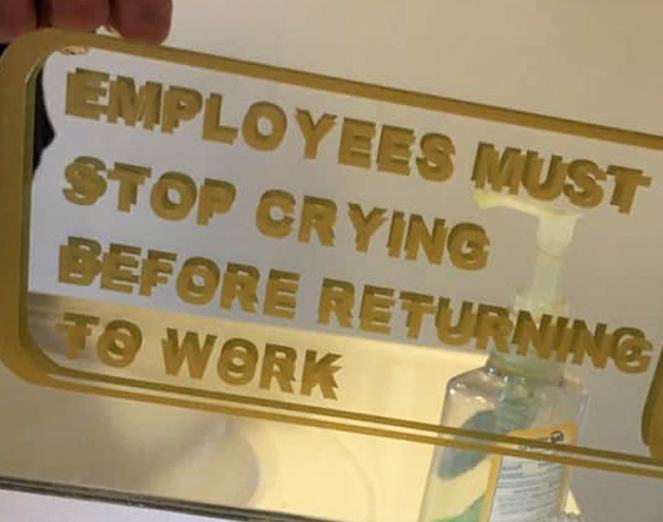
You whiners are losing sight of the big-picture, important stuff, like the unmitigated scandal where Hunter Biden once received a drink on the house.

“So you’re saying that the agency will buy Americans’ location data,” Wyden said. “…doing that without a warrant is an outrageous end run around the fourth amendment. It’s particularly dangerous given the use of artificial intelligence to comb through massive amounts of private information.
“This is exhibit A for why Congress needs to pass our bipartisan, bicameral bill, the Government Surveillance Reform act,” Wyden said, referring to legislation he is working to pass to rein in surveillance.
While law enforcement must get a judge-authorized search warrant to obtain location data directly from telecom companies, government agencies have instead been able to buy such information from private data brokers.
I think Wyden is right, it does sound like an end run around the fourth amendment.
If the FBI (and probably other TLAs, domestic and foreign) are willing to do this now, why would a statute addressing the practice stop them?

I participate in the techtakes community on awful.systems…
Jesus, that sounds awful.
Subscribed.

…like, how sexy are we talking?
The commentariat at HN was anti-DEI before anyone knew what “DEI” even was.
Garry Tan, tech [Y Combinator] CEO & campaign donor, wishes death upon San Francisco politicians

At least her opinion was changeable. By something. For many, that’s not the case.
It’s been 11 years since our president announced he was running for office. She would have been about 24. It’s possible that the biggest thing that changed is: she grew up a little.
Wow, it’s so glitzy, so show-biz, so one-sided, so amorphous in structure. They’ve got the Pooper-in-Chief’s picture up there, in case we forgot who was president from November 2020 to January 2021, when the US had a vaccine but no one could get an injection.
You’d think even a serious conspiracy believer would become suspicious, disillusioned. But I guess that doesn’t happen. Belief in the conspiracy is about feelings of powerlessness and a desire for control, not facts and evidence.
A Very Calm Guide to the Lab Leak Theory (2021, archive.org)
I’m certainly not going to argue that things aren’t bad. I’m not going to tell anyone that they’ve got it better than they think they do.
But I believe I’ve seen the “Most Americans have less than $1,000 saved” factoid bandied about a lot in the headlines. It calls forth such a dismal picture, I’ve been a little skeptical.
The NIRS report (PDF) clarifies that this “less than $1,000 saved” figure is based on some pretty narrow definitions of “saved.” It’s about “working-age Americans (ages 21-64),” so it includes a lot of young people with (no surprise) little or no retirement savings yet. And it’s specifically about savings in employer-organized “defined contribution” (“DC”) savings plans, chief among which is the 401(k) plan.
If you’re a 22 year old college student with a part-time job and $5,000 in the bank, you’re likely to score $0 on this metric anyway, because you probably don’t have a 401(k) yet.
And if you’re a 50-year-old self-employed person who owns a home and a fat Roth IRA, you can still score $0 on this metric. The wealth you’ve stashed in owning a home or a business doesn’t show up here.
So this “less than $1,000 saved” figure isn’t really about how much wealth Americans have saved, it’s more about access to and participation in employer-organized “DC” savings plans, which have long been touted as a private-sector alternative to (and which have almost entirely replaced) pensions.
It would absolutely be better if that figure were higher. But it gets spread around (IMHO) because of it’s emotional impact, not because it’s a particularly clear way of understanding the real-world situation.
I am constantly asked to explain my opinions … I am constantly harangued for proof of what I believe, and every time I hand it over there’s some sort of ham-fisted response of “it’s getting better” and “it will get even more better from here!’
For an industry so thoroughly steeped in cold, hard rationality , AI boosters are so quick to jump to flights of fancy — to speak of the mythical “AGI” and the supposed moment when everything gets cheaper and also powerful enough to be reliable or effective.
I don’t know what’s going to happen with “AI,” but I think this highlights an interesting pattern, one where the standards of evidence for critics and boosters are different. Certainly we’ve seen a similar phenomenon in cryptocurrencies and NFTs.
Is it profound, is it one of those penetrating insights that you can’t stop seeing once you’ve seen it? I’m not sure. Of course enthusiasts are biased, of course their arguments are emotional and unfair.
This is Mr. Every-Accusation-Is-A-Confession speaking.

Could the phone companies really be using that number for unsuspecting customers? I would think they’d block assigning that one. I don’t know anything, though.
Sure sure, but as a fossil fuel executive, answer me this: What if we burned the wind turbines for warmth instead?

George would have some confusion about the “planet Vulcan” bit long before Star Wars, though.
Trump said Tuesday that it’s a “good thing” Kent resigned over his objections to the war with Iran, deriding him as “very weak on security.”
Yeah, I’ll say. What a loser! What kind of numbnuts hired that guy, anyway?
You give somebody who’s used to living paycheck to paycheck a few million bucks and they will spend it.
So they become job creators?
Is the goal to become a rich asshole? Or is the goal for everyone to make $19/hr?
Well I guess those are definitely the only possible outcomes, aren’t they?
We could view this as “MS pushes for stupid direction that clued-in tech people are opposed to,” or we could view this as “MS gives up on native apps because everyone else of consequence already has.” I hate it but I have eyes.
If AI enhanced coding is really so great, we might expect to see a Renaissance of small, efficient native apps, even on platforms like Android. I’m not holding my breath, though.
The term “kill chain” reduces the slaughter of human beings to an engineering problem. It tacitly admits that modern militaries are murder factories. If we had caught ISIS or a drug cartel speaking and thinking this way, that would be a Fox News headline for months. What a dispiriting bit of jargon. It tells so much more than it says.
But do we believe that the pooper-in-chief was hanging on every word coming out of the intelligence apparatus in the hours after the first bombings, alert for any rumor that could be leveraged for the noise machine? Or is it more likely one of the many wormtongues in his orbit whispered this in his ear?










[X] I’m in this picture and I don’t like it